
What is AFFH?
AFFH stands for Affirmatively Furthering Fair Housing, and it’s a provision embedded in the Fair Housing Act, Title VIII of the Civil Rights Act of 1968. While most of us know the Fair Housing Act prohibits discrimination in housing based on race, color, national origin, religion, sex (including gender identity and sexual orientation), and disability, AFFH takes things further.
Rather than simply avoiding discrimination, AFFH requires us to take intentional, proactive steps. It’s about using federal housing funding to ensure people in protected groups have meaningful access to housing and opportunity. According to HUD’s own definition, affirmatively furthering fair housing means “taking meaningful actions, plus to combating discrimination, that overcome patterns of segregation and foster inclusive communities free from barriers that restrict access to opportunity based on protected characteristics.”
This breaks down into two core aspects. First, we’re ensuring no direct discrimination is occurring, including in areas where people from protected groups are systematically screened out or excluded. Second, we’re actively using federal dollars to transform historically marginalized communities into thriving neighborhoods with genuine opportunity.
Practically Speaking
What does that look like in practice? It means addressing significant disparities in housing needs and access to opportunity. It involves replacing segregated living patterns with integrated ones. And critically, the duty extends to all of a program participant’s activities and programs relating to housing and urban development, not just a single initiative or project. Here are some examples of what we mean:
- Ensuring affordable housing is built near public transit lines and quality schools, rather than concentrating it in neighborhoods with limited access to jobs and services
- Replacing segregated living patterns with integrated ones—such as converting single-family-only zoning that excludes lower-income families into mixed-income developments
- Providing housing vouchers that enable families to move into higher-opportunity neighborhoods
- A city receiving Community Development Block Grant funds must consider fair housing in everything—from park development to infrastructure projects, not just its housing programs
It’s also worth noting that while HUD plays the lead role, it’s not the only federal agency with AFFH obligations. The law expressly states that all federal executive departments and agencies handling funds, rulemaking, or enforcement related to housing and urban development must administer their programs to affirmatively further fair housing. That’s why agencies like the Federal Housing Finance Agency and Department of Transportation have signed Memorandums of Understanding with HUD to collaborate on meeting these requirements.
Why Did This Project Happen?
The AFFH provision wasn’t created in a vacuum. It emerged from the Civil Rights Act of 1968, passed in the devastating aftermath of Dr. Martin Luther King Jr.’s assassination. The legislation was meant to honor his life’s work and tackle one of the most stubborn barriers to equality: residential segregation.
Even though federal laws prohibiting overt housing discrimination, segregation persisted, and continues to persist today. Redlining, exclusionary zoning, predatory lending, and discriminatory real estate practices created deeply entrenched patterns of separation and inequality. Communities of color were systematically denied access to wealth-building opportunities, quality schools, safe neighborhoods, and economic advancement.
The 2015 AFFH Rule under the Obama Administration introduced a structured planning process, the Assessment of Fair Housing (AFH), to help communities identify and overcome segregation patterns, increase housing choice, and promote inclusive growth. This framework supported integrated assessment and planning approaches that examined disinvestment and barriers to opportunity, helping align investments in transportation, education, housing, infrastructure, public health, and economic development.
Where Things Stand Today
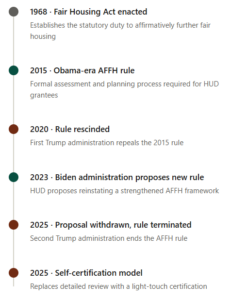
The AFFH rule has been what you might call a political football across several administrations. The Trump Administration gutted the 2015 rule in 2020, stripping it of its enforcement teeth. The Biden Administration removed that harmful rule but failed to carry out a comprehensive final replacement. Instead, they issued an interim rule, “Restoring Affirmatively Furthering Fair Housing Definitions and Certifications”, which required program participants (including local and state governments and public housing agencies) to submit certifications pledging to affirmatively further fair housing in connection with their Consolidated Plans, Annual Action Plans, and PHA Plans.
Crucially, the interim rule didn’t mandate a specific planning process like the AFH. Instead, it created a voluntary approach where participants could use the AFH, the previous Analysis of Impediments (AI) to Fair Housing, or some other means to demonstrate compliance.
On March 3, 2025, HUD published its latest stripped-down version of the AFFH Rule to the federal register. Without a structured approach like the Assessment of Fair Housing or a rigorous Analysis of Impediments, communities may struggle to effectively align federal funding with fair housing goals, potentially weakening efforts to dismantle historical patterns of segregation and economic exclusion.
Some states have stepped in where federal action has lagged. California’s Assembly Bill 686, for instance, created new requirements for cities to affirmatively further fair housing as part of their planning processes, demanding meaningful actions that overcome segregation and foster inclusive communities.
Why It Matters
For those of us working in housing management, compliance, and property operations, AFFH isn’t just a legal checkbox, it fundamentally shapes how we do our jobs and serve residents.
First, it impacts funding. Federal housing dollars come with AFFH obligations. Whether you’re working with Community Development Block Grants, HOME funds, or public housing operating subsidies, your organization must certify its commitment to affirmatively furthering fair housing. Failure to comply can jeopardize funding streams.
Second, it influences planning and decision-making. Where you site new developments, how you market available units, what tenant selection policies you carry out, and how you allocate resources all fall under the AFFH umbrella. We’re required to think critically about whether our actions perpetuate segregation or expand opportunity.
Third, it affects communities. When implemented effectively, AFFH transforms lives. It means families can access neighborhoods with better schools, safer streets, and more economic opportunity. It means children grow up in environments that don’t limit their potential based on zip code. And it means we’re actively working to undo decades of discriminatory policies that have harmed communities of color.
Staying informed is essential. Organizations like the National Fair Housing Alliance offer policy updates and advocacy tools. Resources like the Fair Housing Data Mapping Tool, a collaboration between the National Fair Housing Alliance and the Urban Institute, help us understand segregation patterns and disparities in our regions. At NCHM, we’re committed to helping housing professionals navigate these complex requirements through comprehensive certifications and training that keep you ahead of regulatory changes and industry best practices.
How Does HUD Implement AFFH Requirements?
Although AFFH is federal law, its implementation happens regionally and locally, meaning we’re on the front lines of making it work.
HUD implements AFFH primarily through certification requirements tied to funding. When state and local governments and public housing agencies apply for federal housing funds, they must certify they will affirmatively further fair housing. This certification is attached to Consolidated Plans (ConPlans), Annual Action Plans, and PHA Plans.
Historically, HUD required recipients to complete specific planning documents. The 2015 rule mandated the Assessment of Fair Housing, a detailed analytical tool that required communities to use HUD-provided data, conduct community engagement, identify fair housing issues and contributing factors, set goals, and develop strategies. Before that, communities used the Analysis of Impediments (AI) to Fair Housing, which was less prescriptive but still required identifying barriers and developing remedies.
The current interim framework allows flexibility but also creates uncertainty. Program participants can choose their approach to demonstrating compliance, which can lead to inconsistency in rigor and effectiveness. Some jurisdictions conduct thorough assessments and meaningful planning: others may take a more perfunctory approach.
Beyond certifications, HUD monitors compliance through reviews of plans, on-site monitoring, and complaint investigations. If HUD determines a grantee isn’t meeting its AFFH obligations, it can require corrective action, withhold funding, or terminate participation in programs.
For housing professionals, this means documentation matters. We need to maintain records showing how our policies, practices, and investments support fair housing goals. This includes:
- Affirmative marketing plans that reach diverse populations
- Tenant selection criteria free from discriminatory barriers
- Site selection and occupancy decisions that expand rather than concentrate poverty
- Community engagement that includes voices from protected groups
- Partnerships with fair housing organizations and advocacy groups
It also means staying educated. The regulatory landscape continues to shift, and what’s required today may change tomorrow. Professional development through organizations like NCHM ensures we’re equipped with the knowledge and credentials to navigate compliance confidently, protect our organizations from risk, and eventually serve our communities better.
AFFH isn’t going away. It’s woven into the fabric of fair housing law and will continue to shape how federal housing dollars are spent. Our job is to understand it, carry out it thoughtfully, and use it as a tool to create the inclusive, opportunity-rich communities we all want to live in.
Frequently Asked Questions About Affirmatively Furthering Fair Housing (AFFH)
What does AFFH (Affirmatively Furthering Fair Housing) mean?
AFFH stands for Affirmatively Furthering Fair Housing, a provision of the Fair Housing Act (Title VIII of the Civil Rights Act of 1968). It requires taking meaningful actions using federal housing funding to ensure people in protected groups—those who experienced discrimination based on race, color, national origin, religion, sex, gender identity, sexual orientation, or disability—have access to housing and opportunity in inclusive communities.
How is AFFH different from simply prohibiting housing discrimination?
While the Fair Housing Act prohibits discrimination, AFFH goes further by requiring intentional, proactive steps. It’s not enough to avoid discriminatory practices; organizations must actively use federal dollars to overcome segregation patterns, address housing disparities, and transform historically marginalized areas into thriving neighborhoods with quality schools, jobs, and services.
What federal agencies are responsible for implementing AFFH requirements?
Although HUD leads AFFH implementation, all federal executive departments and agencies handling housing and urban development funds, rulemaking, or enforcement must comply. The Federal Housing Finance Agency, Department of Transportation, and others have signed Memorandums of Understanding with HUD to collaborate and fulfill their AFFH obligations across housing, education, and economic development.
What changed with HUD’s March 2025 AFFH Rule update?
HUD’s March 3, 2025 update removed the structured Assessment of Fair Housing (AFH) requirement. The current interim rule allows program participants—local governments, states, and public housing agencies—to use the AFH, the previous Analysis of Impediments, or other methods to demonstrate compliance, creating flexibility but potentially weakening enforcement consistency.
How does AFFH affect housing professionals and property managers?
AFFH impacts funding eligibility, planning decisions, and tenant selection policies. Housing professionals must maintain documentation showing affirmative marketing plans, nondiscriminatory tenant criteria, equitable site selection, community engagement, and partnerships with fair housing organizations. Compliance is tied to federal housing funding streams like Community Development Block Grants.
What is California’s approach to AFFH requirements?
California Assembly Bill 686 created state-level AFFH requirements for cities to affirmatively further fair housing as part of planning processes. It mandates meaningful actions that overcome segregation patterns and foster inclusive communities free from barriers, complementing federal Fair Housing Act obligations when federal implementation has lagged.